





Warp is a Python framework for writing high-performance simulation and graphics code. Warp takes regular Python functions and JIT compiles them to efficient kernel code that can run on the CPU or GPU.
Warp is designed for spatial computing and comes with a rich set of primitives that make it easy to write programs for physics simulation, perception, robotics, and geometry processing. In addition, Warp kernels are differentiable and can be used as part of machine-learning pipelines with frameworks such as PyTorch, JAX and Paddle.
Please refer to the project Documentation for API and language reference and CHANGELOG.md for release history.

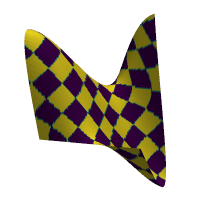
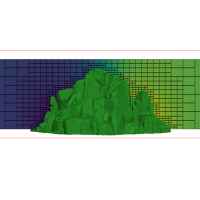
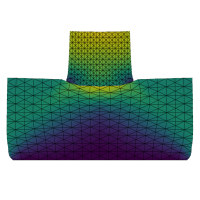
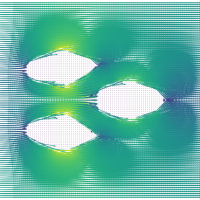
A selection of physical simulations computed with Warp
Python version 3.9 or newer is required. Warp can run on x86-64 and ARMv8 CPUs on Windows and Linux, and on Apple Silicon (ARMv8) on macOS. GPU support requires a CUDA-capable NVIDIA GPU and driver (minimum GeForce GTX 9xx).
The easiest way to install Warp is from PyPI:
pip install warp-lang
You can also use pip install warp-lang[examples] to install additional dependencies for running examples and USD-related features.
For nightly builds, conda, CUDA 13 builds, building from source, and CUDA driver requirements, see the Installation Guide.
The NVIDIA Accelerated Computing Hub contains the current, actively maintained set of Warp tutorials:
| Notebook | Colab Link |
|---|---|
| Introduction to NVIDIA Warp |  |
| GPU-Accelerated Ising Model Simulation in NVIDIA Warp | |
Additionally, several notebooks in the notebooks directory provide additional examples and cover key Warp features:
The warp/examples directory contains a number of scripts categorized under subdirectories that show how to implement various simulation methods using the Warp API. Most examples will generate USD files containing time-sampled animations in the current working directory. Before running examples, install the optional example dependencies using:
pip install warp-lang[examples]
On Linux aarch64 systems (e.g., NVIDIA DGX Spark), the [examples] extra automatically installs
usd-exchange instead of usd-core as a drop-in replacement,
since usd-core wheels are not available for that platform.
Examples can be run from the command-line as follows:
python -m warp.examples.<example_subdir>.<example>
To browse the example source code, you can open the directory where the files are located like this:
python -m warp.examples.browse
Most examples can be run on either the CPU or a CUDA-capable device, but a handful require a CUDA-capable device. These are marked at the top of the example script.
USD files can be viewed or rendered inside NVIDIA Omniverse, Pixar's UsdView, and Blender. Note that Preview in macOS is not recommended as it has limited support for time-sampled animations.
Built-in unit tests can be run from the command-line as follows:
python -m warp.tests
 |
 |
 |
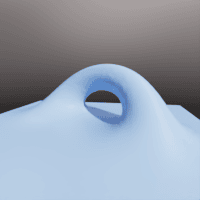 |
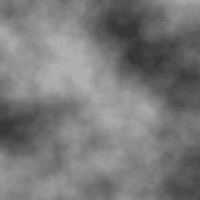
| dem | fluid | graph capture | marching cubes |
 |
 |
 |
 |
| mesh | nvdb | raycast | raymarch |
 |
 |
 |
 |
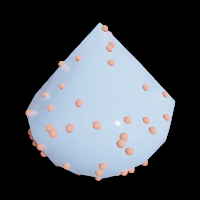
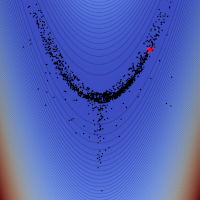
| sample mesh | sph | torch | wave |
 |
 |
 |
 |
| diffusion 3d | mixed elasticity | apic fluid | streamlines |
 |
 |
 |
 |
| distortion energy | navier stokes | burgers | magnetostatics |
 |
 |
 |
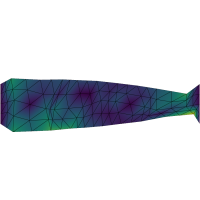 |
| adaptive grid | nonconforming contact | darcy level-set optimization | elastic shape optimization |
 |
 |
 |
|
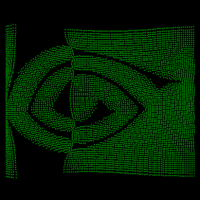
| diffray | fluid checkpoint | particle repulsion |
 |
 |
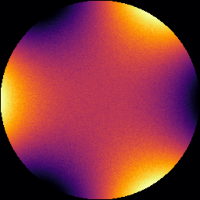 |
|
| mlp | nbody | mcgp |
Please see the following resources for additional background on Warp:
- Product Page
- SIGGRAPH 2024 Course Slides
- GTC 2024 Presentation
- GTC 2022 Presentation
- GTC 2021 Presentation
- SIGGRAPH Asia 2021 Differentiable Simulation Course
The underlying technology in Warp has been used in a number of research projects at NVIDIA including the following publications:
- Accelerated Policy Learning with Parallel Differentiable Simulation - Xu, J., Makoviychuk, V., Narang, Y., Ramos, F., Matusik, W., Garg, A., & Macklin, M. (2022)
- DiSECt: Differentiable Simulator for Robotic Cutting - Heiden, E., Macklin, M., Narang, Y., Fox, D., Garg, A., & Ramos, F (2021)
- gradSim: Differentiable Simulation for System Identification and Visuomotor Control - Murthy, J. Krishna, Miles Macklin, Florian Golemo, Vikram Voleti, Linda Petrini, Martin Weiss, Breandan Considine et al. (2021)
See the FAQ in the Warp documentation.
Problems, questions, and feature requests can be opened on GitHub Issues.
For inquiries not suited for GitHub Issues, please email warp-python@nvidia.com.
Warp is provided under the Apache License, Version 2.0. Please see LICENSE.md for full license text.
This project will download and install additional third-party open source software projects. Review the license terms of these open source projects before use.
Contributions and pull requests from the community are welcome. Please see the Contribution Guide for more information on contributing to the development of Warp.
Our PUBLICATIONS.md file lists academic and research publications that leverage the capabilities of Warp. We encourage you to add your own published work using Warp to this list.
If you use Warp in your research, please use the "Cite this repository" button on the GitHub repository page or refer to the CITATION.cff file for citation information.


